How teams should decide on managed OpenClaw hosting without ideology or guesswork
Problem statement: you are not looking for propaganda about why managed hosting is always better. You want a clear framework for deciding when managed OpenClaw hosting makes sense for your team, when self-hosting is still the rational choice, and how to evaluate the tradeoffs without guessing.
- TechCrunch 2026-03-16 coverage on NVIDIA NemoClaw security framing highlights how enterprise deployments need hardened runtimes and clear trust boundaries.
- Tom's Hardware 2026-03-17 report on OpenClaw adoption surge notes that security and reliability concerns are rising as more teams move into production.
- YouTube 2026-03-19 coverage of managed hosting launches shows the market shifting toward easier deployment paths for teams that want outcomes over infrastructure chores.
The mistake most teams make: deciding based on cost alone
Infrastructure line items are easy to compare. Your VM costs X dollars, managed hosting costs Y dollars. This looks like a simple math problem. But this framing misses the actual costs that matter in practice: incident response time, security maintenance burden, upgrade firefighting, and the opportunity cost of engineers spending time on platform work instead of product work.
The right decision framework starts with a different question: where does your team need to spend its scarce attention?
Decision framework: four questions that actually matter
1) Do you have stable DevOps capacity for OpenClaw specifically?
Having general DevOps skills is not the same as having someone who owns OpenClaw operations end-to-end. The real question is whether someone on your team is responsible for monitoring OpenClaw health, tracking security updates, maintaining channel reliability, and responding to incidents.
If the answer is unclear or fragmented, managed hosting removes the ambiguity by providing a baseline operational model.
2) What happens to your product timelines when OpenClaw has issues?
In some teams, an OpenClaw outage is a minor inconvenience. In others, it blocks customer-facing features or internal operations that the business depends on. The threshold for managed hosting should be based on business impact, not philosophical preference for self-hosting.
- Low impact: OpenClaw is experimental, uptime is flexible, incidents are acceptable.
- Medium impact: OpenClaw supports important workflows but delays are tolerable.
- High impact: OpenClaw is part of production operations and downtime directly affects users or revenue.
At high impact, the cost of incidents and maintenance usually exceeds the cost of managed hosting.
3) Can you absorb security hardening as ongoing work?
OpenClaw security is not a one-time setup. It requires tracking CVEs, managing credential exposure, securing access controls, and staying aligned with a fast-moving upstream. Public discussions around security concerns after the Chinese AI restrictions show that teams are waking up to how much work this actually is.
Managed hosting does not eliminate security responsibility entirely, but it provides isolated runtime boundaries, encrypted credential storage, allowlist controls, and managed updates as baseline defaults rather than DIY projects.
4) What is your actual runway for infrastructure work?
Some teams are in a phase where infrastructure is part of the product and they want to invest in it. Others are in execution mode and need to minimize distraction. The right hosting choice depends on your current runway, not some hypothetical future state where you suddenly have more time.
Decision matrix: score your current state
Rate each item 0–3 (0 = no problem, 3 = severe recurring problem):
- OpenClaw incidents or firefighting in the last 30 days.
- Upgrade releases require manual recovery work.
- Channel reliability problems (messaging failures, delivery issues).
- Security hardening work is accumulating.
- No clear owner for OpenClaw operations.
- Engineers pulled off product work for infrastructure issues.
Interpretation
0–4 points: Self-hosting is working well for your current stage. Consider managed hosting only when your scale or security requirements change.
5–9 points: Hybrid model may fit. Keep experimental or low-risk workloads self-hosted, move production or high-value workflows to managed.
10+ points: Managed hosting is likely the rational choice for your current state. The operational burden is costing more than the hosting would.
What managed OpenClaw hosting actually includes
Before deciding, you should understand what managed hosting replaces in your operational stack:
- Isolated runtime: instances run in separated environments without public IP exposure.
- Credential management: API keys are encrypted at rest (AES-256-GCM) and kept separate from the agent runtime.
- Access controls: allowlist-based messaging limits who can interact with your assistant.
- Usage visibility: token and cost analytics by model are built into the dashboard.
- Managed updates: security hardening and stability improvements are applied daily.
- Dashboard operations: cron jobs, agents, workspace editing, and environment variables are manageable from the UI.
The operational model removes entire classes of recurring work: server provisioning, network hardening, patch management, and manual monitoring setup. This is valuable when your team is scarce and infrastructure work is not your differentiator.
Evidence from the field: what successful migrations actually look like
Teams that successfully adopt managed hosting usually share a pattern: they start with one bounded workflow, validate that the managed environment meets their reliability and security needs, then expand based on evidence rather than anxiety.
The import-first approach—exporting a self-hosted instance configuration and importing it into managed hosting—preserves workflows and context while shifting the operational burden. This matters because the biggest fear teams express is losing what they have already built.
Internal operational notes from hosted deployments show that the clearest benefits appear quickly: fewer fire drills around upgrades, predictable costs instead of surprise infrastructure bills, and engineers staying focused on product work instead of platform maintenance.
Edge cases where self-hosting is still the right call
- Custom infrastructure requirements: your networking, compliance, or integration needs cannot be met by a managed platform.
- Infra-heavy teams: your team is explicitly building infrastructure as part of the product and wants full control.
- Experimental stage: OpenClaw usage is exploratory and uptime is not critical.
- Existing mature ops: you already have robust monitoring, security processes, and incident response for OpenClaw specifically.
Typical mistakes that lead to regret
- Deciding based on ideology instead of actual business impact and team capacity.
- Underestimating the ongoing cost of security maintenance and upgrade firefighting.
- Assuming migration is harder than it actually is (modern import flows preserve workflows).
- Choosing self-hosting when nobody actually owns OpenClaw operations end-to-end.
- Deferring the decision until an incident forces a rushed migration.
How to validate your decision
- Run the decision matrix and score your current state honestly.
- Identify your actual business impact if OpenClaw is unreliable for 24–48 hours.
- Check whether anyone on your team is explicitly responsible for OpenClaw operations.
- If considering managed hosting, import one non-critical workflow as a pilot.
- Compare operational burden and outcomes after 30 days instead of relying on intuition.
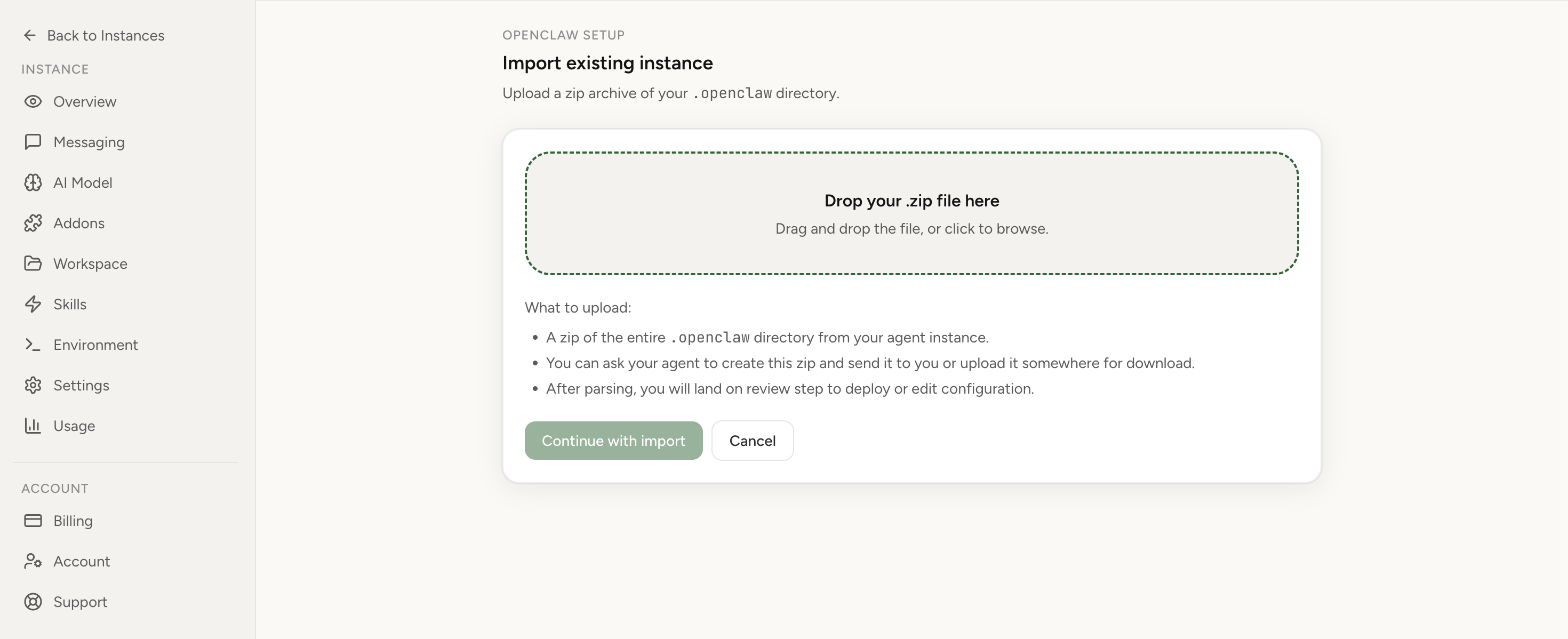
If you want to evaluate managed hosting with minimal risk, use Import your current OpenClaw instance in 1 click to test a pilot workflow without rebuilding from zero. Then compare models at /compare/ and review the feature set and managed hosting details before committing your production workloads.
Import your current OpenClaw instance in 1 click
Test managed hosting with your existing workflows instead of rebuilding from scratch. Import one instance as a pilot, validate reliability and security, then expand based on evidence.
FAQ
Does managed hosting mean giving up control?
No. You keep control over workflows, prompts, model selection, and integrations. What you give up is low-level infrastructure responsibility and the operational burden that comes with it. For most teams, that is the right trade: keep control over the things that differentiate your product, let someone else handle the platform plumbing.
How long does it take to validate managed hosting?
Most teams can run a meaningful pilot in days and reach a confident decision within 30 days. The import flow lets you test with real workflows instead of artificial demos, so you get evidence rather than speculation.
Can we change our minds later?
Yes. Workspace exports and the import flow work in both directions. The best approach is to treat hosting as a decision you revisit as your team, scale, and requirements change rather than a permanent ideological commitment.
Sources
- TechCrunch (2026-03-16): NVIDIA NemoClaw security framing for enterprise AI agents
- Tom's Hardware (2026-03-17): OpenClaw adoption surge and security concerns
- YouTube (2026-03-19): Managed OpenClaw hosting launch and Abacus Claw
- OpenClaw Setup: multi-agent routing and team operations
- OpenClaw Setup: hosted cron job management