Move OpenClaw to managed hosting without losing context, workflows, or trust
Problem statement: you do not want to abandon OpenClaw. You want to stop babysitting it. Maybe your self-hosted setup proved the value, but now upgrades, browser connectivity, security checks, and late-night debugging are pulling time away from the work the assistant was supposed to save. The hard part is not deciding to move. The hard part is moving without losing memory, workflow continuity, and operator confidence.
- A 2026-03-08 operator write-up argues that a small VPS can be cheaper than cloud, but also makes the tradeoff explicit: you own uptime, restarts, and maintenance yourself.
- A 2026-03-10 security-focused article on self-hosted OpenClaw makes the same practical point from a different angle: local control does not remove the need for hardening, monitoring, and clear trust boundaries.
- Recent community discussion and hosted OpenClaw launches continue to show interest in easier deployment paths for teams that want outcomes more than infrastructure chores.
Why teams migrate even when self-hosting “works”
Most migrations do not start because the stack is completely broken. They start because the operating cost becomes harder to justify. The server bill may be low. The real cost shows up elsewhere: release windows, browser wiring, security reviews, backup planning, channel troubleshooting, and the background mental load of knowing that if something drifts, your team is the incident response team.
That distinction matters. If self-hosting no longer saves the kind of cost that matters to you, moving is not a failure. It is a maturity decision.
What people really mean by “I do not want to lose context”
Context is larger than chat history. In practice, teams worry about five things:
- Memory continuity: files, notes, and working patterns that make the assistant useful.
- Workflow continuity: channels, recurring tasks, and the habits people already built around the assistant.
- Behavior continuity: confidence that the agent will not suddenly feel like a different tool after the move.
- Operational continuity: minimal downtime and a rollback path if something looks wrong.
- Business continuity: customer-facing or internal tasks keep moving while the platform changes underneath them.
A good migration plan addresses all five. A weak migration plan focuses only on where the server runs.
The migration sequence that avoids panic
1) Freeze the current state before you move
Start by documenting the exact pieces of the current setup that matter: current channels, core workflows, critical files, any browser-dependent flows, and the signs your team uses to decide “the assistant is healthy.” You cannot preserve what you never defined.
2) Separate essentials from experiments
Most self-hosted setups contain a mix of production workflows and experiments. Do not migrate all of it as one blob. Split the assistant into what must survive intact and what can be rebuilt or retired. This reduces risk and keeps the project from turning into a digital attic move.
3) Preserve memory deliberately
Memory should not be treated as leftover text files you remember at the last minute. It is part of the product value. Inventory the memory and workspace assets that directly influence output quality, priorities, and continuity. If the agent helps with business operations, losing these files can feel like resetting a trained teammate back to day one.
4) Migrate one important workflow first
Do not try to prove the move by migrating every task at the same time. Pick one important workflow with clear success criteria. A successful narrow migration gives your team evidence and confidence. A giant all-at-once migration usually creates noise and fear.
5) Validate operator trust, not just technical success
Technical success means the assistant runs. Operator trust means the people using it believe it is safe to depend on again. That requires clean responses, expected timing, visible continuity, and no surprising gaps in the flows they already know.
How to move without rebuilding from scratch
Teams often assume migration means starting over. That is exactly the fear that delays good decisions. In reality, the better path is import first, then refine. Import preserves momentum. Rebuild-from-zero destroys it unless your current setup is already beyond repair.
A practical migration path
- Capture your current instance state and essential files.
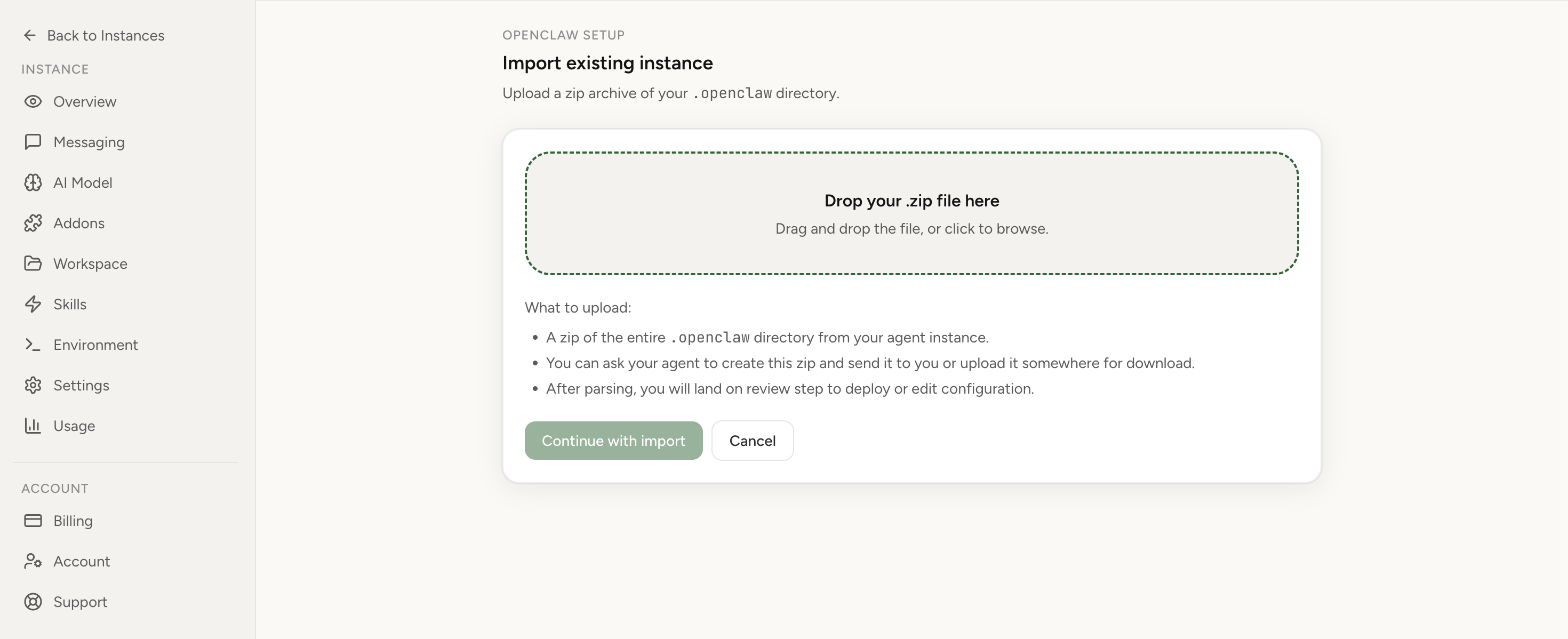
- Import the instance instead of recreating every setting manually.
- Verify one primary workflow end to end.
- Review what can stay self-hosted for experiments versus what belongs on managed runtime.
- Expand only after the first workflow feels boringly reliable.
Where migrations usually fail
The team tries to move too much at once
Broad moves create confusing symptoms. When messaging, cron, browser work, and team knowledge files all change at once, nobody knows whether the migration succeeded or failed. Narrow scope is not slower. It is what makes progress measurable.
People focus on files, not habits
If a team is used to interacting with the assistant in a certain way, preserving those expectations matters. Migration is not just data transfer. It is user trust transfer.
There is no rollback plan
The fastest way to make operators resist migration is to tell them there is no easy way back if something looks wrong. A calm rollback option makes adoption easier even if you never need it.
How to validate that the moved setup is truly ready
- One real workflow works from start to finish with expected timing.
- Important memory or workspace context is still available where needed.
- At least one operator other than the person performing the migration trusts the result enough to use it.
- Fallback or rollback path is documented.
- The moved setup reduces routine operational effort instead of simply relocating it.
That last point is easy to miss. If the move only changes hosting location but not the burden on your team, it was not a meaningful improvement.
Edge cases to plan for
- Browser-heavy workflows: verify them separately because local browser complexity often behaves differently from chat-only tasks.
- Mixed experimental and production skills: not all of them deserve to be carried forward.
- Team-specific memory practices: some groups rely heavily on workspace files that are easy to forget.
- Security-sensitive environments: migration may improve operations while still requiring careful review of scopes and permissions.
- Founders wearing too many hats: the greatest gain may be attention recovered, not infrastructure elegance.
Typical mistakes that make migration feel worse than it is
- Trying to prove toughness by rebuilding manually instead of importing.
- Assuming the cheapest infrastructure is automatically the best long-term decision.
- Forgetting to define what “nothing important was lost” actually means.
- Moving during a busy week with no protected validation time.
- Keeping everything self-hosted out of habit even after the original reason disappeared.
What the decision looks like in business terms
The right migration question is not “can we still self-host?” It is “where should our team spend its scarce attention?” If your work depends on OpenClaw output quality and continuity, the best setup is the one that creates the fewest avoidable interruptions while preserving the value you already built. Sometimes that remains self-hosted. Sometimes it becomes a hybrid. Sometimes managed hosting is the obvious next step.
If you want the fastest low-risk path, start with Import your current OpenClaw instance in 1 click. Then compare operating models at /compare/ and review the hosted environment at /openclaw-cloud-hosting/. If you are still deciding whether to keep some flows local, the baseline self-hosted path is at /openclaw-setup/.
Import your current OpenClaw instance in 1 click
Keep the useful parts of your current setup instead of recreating them by hand. Import first, verify one live workflow, then expand when the moved environment proves itself.
FAQ
Will moving to managed hosting make my assistant feel different?
It should not feel randomly different if you preserve the important context and validate the real workflows people already use.
Should I migrate experiments too?
Usually no. Move the workflows that matter first. Keep experiments separate until the production path is stable.
What is the clearest sign that now is the right time to move?
When the assistant saves less time than the team spends maintaining it, migration becomes a practical business decision, not a philosophical one.