From “this demo is amazing” to “this runs every day”: the OpenClaw team adoption playbook
Problem statement: OpenClaw interest is exploding, but many teams stall between local excitement and dependable daily operations. This guide shows how to make the jump without losing momentum.
- Hacker News discussion “Show HN: DenchClaw – Local CRM on Top of OpenClaw” (item 47309953, posted 1 day ago) shows high demand for local-first OpenClaw workflows and practical business use cases.
- In parallel, operators continue reporting reliability friction in current deployments, including scheduler and remote-control incidents in GitHub issues this week.
The adoption gap nobody talks about enough
Demos optimize for possibility. Production optimizes for repeatability. That mismatch is where most teams get stuck. In a demo, one person runs one happy-path flow and shares a screenshot. In production, many people depend on the same system every day, often across different channels, devices, and network conditions.
The good news: this is solvable with an operating model, not heroics. Teams that scale OpenClaw successfully do three things early: they narrow scope, define ownership, and standardize deployment pathways before adding complexity.
What changes from solo experimentation to team operations
| Phase | Primary question | Winning behavior |
|---|---|---|
| Demo | Can this do something useful? | Ship one visible result fast |
| Pilot | Can this help a real workflow? | Limit use case count and define owner |
| Team rollout | Can this run reliably every day? | Template deployment, monitoring, incident runbook |
| Scale | Can we expand without fragility? | SLOs, change control, and measured expansion |
A practical 30-day rollout plan
Week 1: lock one high-value workflow
- Choose one repeatable workflow with visible business impact.
- Define owner, backup owner, and service expectations.
- Document exact trigger, expected output, and failure criteria.
- Avoid adding secondary channels until the first path is stable.
Week 2: harden environment and access model
- Standardize one deployment pattern (container or managed runtime).
- Establish one canonical UI/domain path for operators.
- Set clear policy for credentials, secrets rotation, and logs.
- Test browser tooling paths, including Chrome Extension Relay when needed.
Week 3: add observability and incident handling
- Track queue-to-run latency and error classes for core jobs.
- Add alerting with owner routing and escalation steps.
- Practice one simulated failure and recovery drill.
- Update runbook with exact commands and expected evidence.
Week 4: decide scale pathway
- Measure engineering time spent on maintenance vs feature delivery.
- Compare self-hosted and managed paths using explicit criteria.
- Plan either controlled expansion or migration with zero blind spots.
Decision framework: keep self-hosted or move to managed
Self-hosting remains a strong choice when your team has clear platform ownership, predictable traffic, and mature operational discipline. Managed hosting becomes compelling when maintenance interrupts product velocity, on-call load is growing, or deployment drift causes repeated incidents.
- Reliability risk: how often critical automations miss schedule or output quality?
- Security burden: how many security and patching tasks require manual intervention?
- Team focus: are engineers building product value or maintaining runtime plumbing?
- Growth readiness: can the current setup support 2–3× usage without fragility?
Native migration CTA for teams already feeling the drag
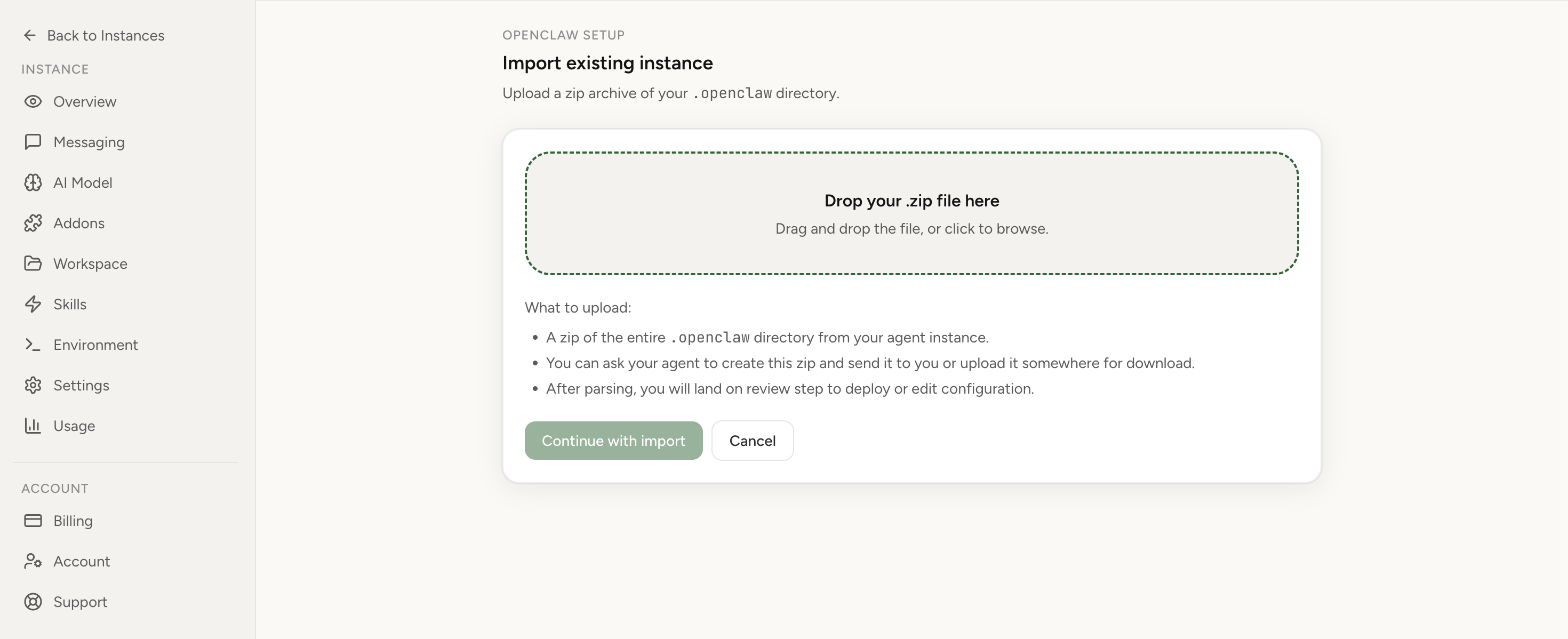
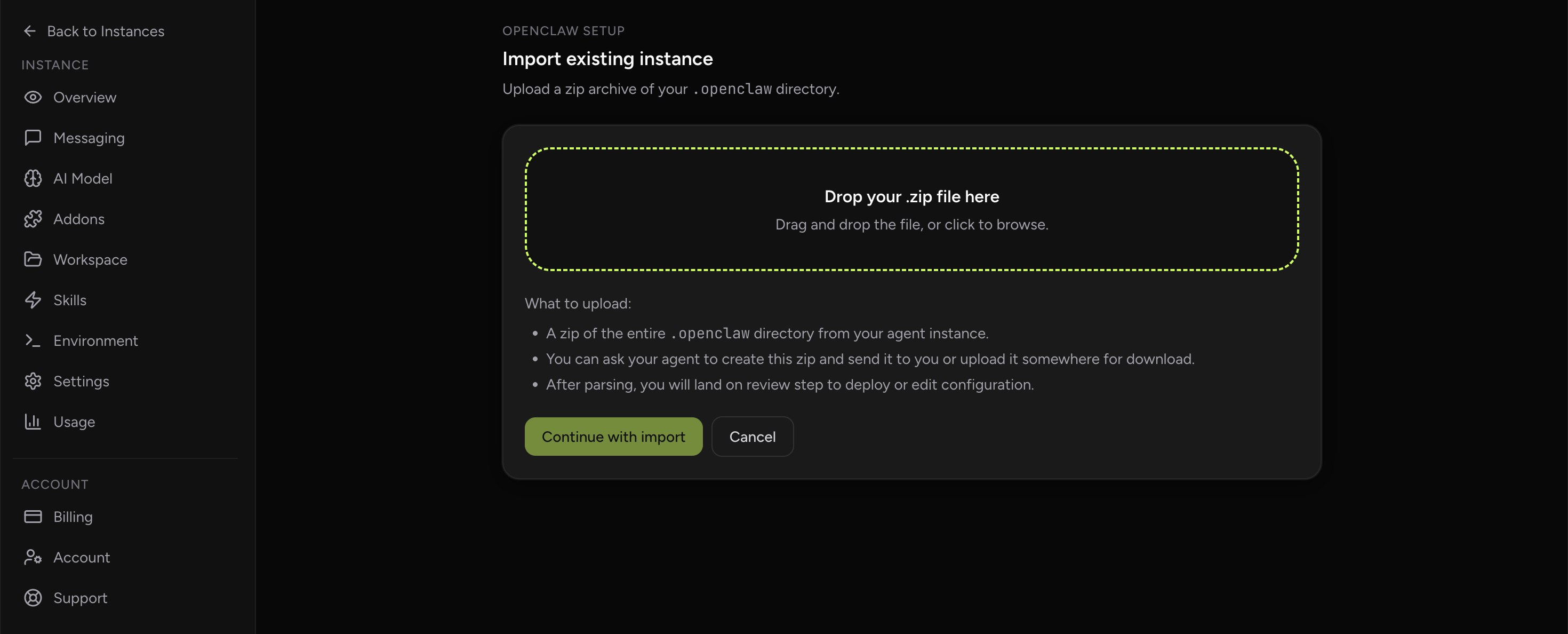
Import your current OpenClaw instance in 1 click
If your team keeps losing time to maintenance instead of shipping, keep your existing setup context and move with a safer rollout path. Start import, validate your instance, and launch with production defaults.
What strong teams measure from day one
The fastest way to lose momentum is measuring vanity metrics only, such as number of demos shared or agents created. Instead, track outcomes that prove operational value: successful run rate for core workflows, queue-to-completion time, operator intervention frequency, and business result linked to each automation. These metrics make planning and budget decisions clear, especially when deciding whether to stay self-hosted or move part of the stack to managed hosting.
- Reliability: weekly success rate of business-critical automations.
- Speed: median queue-to-output time for recurring tasks.
- Quality: output acceptance rate without manual rewrite.
- Effort: engineering hours spent on maintenance versus feature delivery.
Governance model that keeps adoption healthy
Governance is not bureaucracy. It is role clarity. Define who can add tools, who approves production automations, who owns incident response, and who signs off on upgrades. Without this, early wins can quickly turn into conflicting changes and unpredictable runtime behavior.
A lightweight model works well: one product owner for workflow priority, one platform owner for runtime reliability, and one security reviewer for policy-sensitive automations. Keep decisions documented in one place so future rollout waves do not repeat earlier mistakes.
Typical mistakes during team rollout
Mistake 1: expanding channels before stabilizing one
Teams add Telegram, Slack, browser actions, and scheduled jobs all at once. This multiplies failure surfaces and slows root-cause analysis. Stabilize one path, then add one channel at a time.
Mistake 2: no owner for runtime reliability
Product teams assume platform stability “just happens.” Without clear runtime ownership, incident response becomes slow, reactive, and inconsistent.
Mistake 3: no acceptance criteria for automation quality
“It ran” is not enough. Define output quality checks and SLA windows, especially for customer-facing automation.
How to verify your operating model is truly ready
- One documented owner and one backup owner for each critical workflow.
- At least 14 days of stable run history on your core automations.
- Change management process for upgrades and rollback.
- Incident runbook tested by someone other than the original setup engineer.
- A clear decision record on self-hosted vs managed for the next quarter.
Final readiness checkpoint before broader rollout
Before expanding to additional teams, run one formal readiness review: confirm reliability metrics are stable, confirm incident ownership is clear, and confirm every critical workflow has fallback behavior. Teams that pause for this checkpoint usually scale faster because they avoid compounding unstable foundations.
FAQ
Is managed hosting only for large enterprises?
No. Small teams adopt it when reliability work starts consuming product time. The threshold is operational pain, not company size.
Can we mix self-hosted and managed during transition?
Yes. Many teams keep low-risk workflows self-hosted while moving high-impact automations first.
Where should we begin today?
Start with baseline setup practices at /openclaw-setup/, review decision criteria at /compare/, and evaluate deployment paths on /openclaw-cloud-hosting/.