OpenClaw exec tool missing: how to restore command execution safely
Problem statement: your automations suddenly stop running shell tasks and OpenClaw reports
Unable to load exec tool or permission-related errors. This is a high-impact failure because many workflows
depend on command execution for deploy checks, file processing, and quick diagnostics.
- Issue #37466 (2026-03-06): users report exec tool cannot load.
- Issue #37476 (2026-03-06): permission controls break command workflows after updates.
- Community Q&A mirrors this pattern: operators can open UI normally, but command-capable tasks fail at runtime.
Why this failure appears "random"
In most teams, exec failures look random because multiple layers can break independently: plugin registration, security policy, runtime environment variables, or stale daemon processes. The UI may still look healthy, which leads people to chase the wrong root cause. You need to treat this as an initialization-path problem, not just a missing binary problem.
Root-cause map
- Plugin state drift: tool metadata exists, but runtime cannot initialize the exec provider.
- Policy mismatch: permission prompts or deny rules block command execution at load time.
- Stale daemon context: config was updated, but gateway still runs with previous environment.
- Path resolution issues: process starts under one user path while tool expectations point elsewhere.
- Dependency mismatch: update changed required runtime assumptions and old cached state remains.
Step-by-step diagnosis and recovery
1) Freeze context before making changes
- Capture exact error text and timestamp from logs.
- Record current OpenClaw config and active runtime mode.
- Save one failing request payload (redact secrets).
2) Confirm service health first
Verify gateway is up and other tools load. If only exec fails, you have isolated scope quickly. If multiple tools fail, pause and handle broader runtime regression first.
3) Validate permission model explicitly
Recent reports show command execution can break when permission defaults change or become stricter after upgrade. Ensure your current policy still allows the needed execution path. A hidden deny rule often looks like a loading failure.
4) Reinitialize plugin registration safely
Avoid random reinstall loops. Reinitialize only the tool/plugin registration path, then restart the gateway once. This preserves evidence while cleaning invalid state.
5) Compare interactive shell vs daemon environment
Many incidents come from environment drift: your shell has expected paths, but daemon startup environment does not. Compare user, working directory, and key environment variables used for command execution.
6) Run a minimal exec smoke test
Use a single harmless command first. If this fails, stay in initialization debugging. If it passes, move to real workflow tests.
7) Test one production-like workflow
A passing smoke test is not enough. Run one workflow that previously failed and confirm command output is correctly returned to the agent. This ensures load path and execution path are both healthy.
8) Restart and retest for persistence
Rebooting service often reintroduces hidden config problems. Perform one controlled restart and rerun your smoke test + workflow test.
9) Add ongoing guardrails
- Preflight check that exec tool loads before daily automations start.
- Alert on repeated "Unable to load exec tool" messages.
- Keep rollout notes for policy changes and update windows.
Practical fixes for common patterns
Pattern A: tool fails immediately after update
Confirm whether policy defaults changed. If yes, align your rules with your workflow requirements, then restart gateway once. If incident started exactly at update time and no local config changed, keep a rollback option ready while upstream fixes land.
Pattern B: tool works in terminal, fails in chat workflow
This usually indicates environment mismatch. Terminal commands use your interactive shell profile, while gateway may run under a cleaner service environment. Align path variables and working-directory assumptions so both paths execute the same binary.
Pattern C: permission popup loops or command blocked silently
Treat this as policy configuration debt. Make command permissions explicit and avoid mixed defaults. Silent blocks create the illusion of flaky tooling when the rule engine is actually doing what it was told.
Edge cases teams miss
- Two OpenClaw installs on one machine: one path updates, the other runs.
- Old lock/state files: stale runtime metadata points to removed tool paths.
- Container vs host assumptions: exec enabled in one context but denied in another.
- Group-chat safety mode: restrictive mode blocks command execution by design.
- Overlapping policy files: local override silently supersedes expected defaults.
Verification checklist
- Three consecutive exec smoke tests pass.
- At least one real workflow with command execution completes successfully.
- No new exec load errors appear after service restart.
- Permission policy documented and committed.
- On-call runbook updated with exact fix steps.
Typical mistakes that prolong downtime
- Reinstalling repeatedly without preserving logs.
- Changing policy, runtime, and version all at once.
- Assuming one successful command means full recovery.
- Ignoring restart persistence tests.
- Skipping clear ownership for permission policy changes.
If exec incidents keep interrupting your team, move your current instance to a managed runtime and keep command workflows stable without repetitive environment debugging.
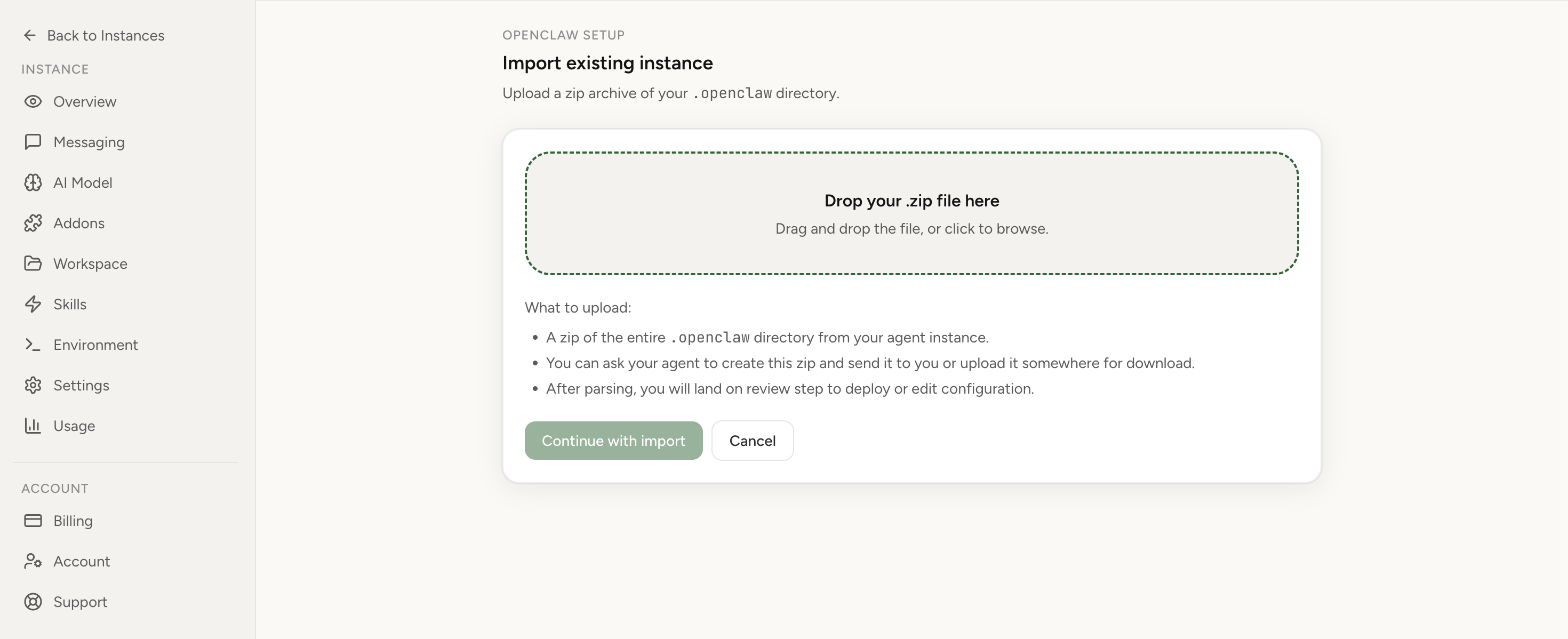
Import your current OpenClaw instance in 1 click Compare self-managed vs managed
Fix once. Stop recurring exec tool load failures.
If this keeps coming back, you can move your existing setup to managed OpenClaw cloud hosting instead of rebuilding the same stack. Import your current instance, keep your context, and move onto a runtime with lower ops overhead.
- Import flow in ~1 minute
- Keep your current instance context
- Run with managed security and reliability defaults
If you would rather compare options first, review OpenClaw cloud hosting or see the best OpenClaw hosting options before deciding.
How to prevent this in future releases
The most reliable teams treat tool loading as a release gate. Before promoting any update, they run a small acceptance suite: gateway startup, tool-load check, one command smoke test, and one real workflow test. This process catches policy drift before users do. Add a simple release checklist and make it mandatory for production rollouts.
Also define a change window for permission policy edits. Most exec incidents happen when policy changes and runtime upgrades happen together. Decoupling these events makes debugging far simpler and prevents finger-pointing across teams.
Recommended control set
- Daily health check: validate exec tool load status before business hours.
- Version ring rollout: one canary host, then staged expansion.
- Policy-as-code review: peer review any command permission changes.
- Recovery script: one-click restart + validation bundle for incidents.
- Post-incident learning: add concrete prevention note after every outage.
If you prefer to stay self-managed, keep your baseline hardened with the setup guide at /openclaw-setup/. If you run browser-heavy tasks too, pair this with the relay best practices at /features/chrome-extension-relay/. And if your team needs a clear operational comparison, review /compare/ before your next quarter planning cycle.
FAQ
Can a missing exec tool be caused by filesystem permissions only?
Sometimes, but not always. Filesystem permissions are common, yet policy and environment mismatch are equally frequent causes.
Should we disable safety prompts to avoid command failures?
No. Keep safety prompts and permission policies. Instead, configure explicit allow rules for approved workflows and verify them with tests.
What is the best long-term metric to track?
Track command-workflow success rate and mean time to recover from exec incidents. Those metrics expose reliability trends early.
Sources
- OpenClaw issue #37466 (created 2026-03-06)
- OpenClaw issue #37476 (created 2026-03-06)
- OpenClaw documentation (runtime and tool behavior references)