OpenClaw logs fail after upgrade even though the gateway is healthy: full diagnosis and safe recovery
Problem statement: you run openclaw logs --follow, get told the gateway is not reachable,
and immediately assume your whole runtime is down. Then openclaw status still works, the gateway answers
local probes, and the situation makes no sense. This is a real failure pattern, and the dangerous part is not just the
broken log stream. It is the misleading diagnosis.
- Issue #44714 (2026-03-24 fetch of a public report):
openclaw logs --followfails after upgrading from 2026.3.11 to 2026.3.12. - The public report shows healthy
openclaw statusandopenclaw gateway statusresponses on the same host. - The gateway log shows repeated
handshake-timeoutfailures around 3.5–3.8 seconds while the default handshake timeout is 3000 ms. - The CLI then surfaces a broad “Gateway not reachable” message even though the failure is isolated to the log-stream connection path.
Why this error burns so much time
Operators trust log tooling because it is often the first thing they use in an incident. When log access breaks, people naturally assume the gateway itself is failing. That assumption sends you into the wrong branch of the troubleshooting tree: process restarts, port checks, DNS guesses, firewall edits, or even emergency rollback before you have proven where the fault really lives.
The better frame is simpler: separate runtime health from log-stream health. If status, gateway status, and a local HTTP probe still work, you may be looking at a stream-attachment regression rather than a dead runtime. That distinction matters because the recovery sequence changes. You need evidence capture first, not blind restarts.
Evidence from the field
This article clears the evidence bar for one reason: the incident pattern is concrete, recent, and operationally useful. The public issue does not describe a vague “logs broken after upgrade” complaint. It provides the exact mismatch operators care about:
- The same local deployment worked before the upgrade.
- General health paths still returned success.
- The failure was isolated to the logs path.
- The gateway recorded handshake timing that exceeded the default threshold.
- A direct file-tail workaround restored visibility quickly enough to continue diagnosis.
That is enough to produce a battle-tested runbook: prove scope first, recover visibility second, and only then decide whether you need rollback, patching, or a platform change. If you skip that order, you lose the one thing you need during an incident: confidence in what is actually broken.
How to recognize this failure pattern fast
openclaw logs --followfails immediately or within a few seconds.- The CLI says the gateway is not reachable even though the gateway service is running.
openclaw statusandopenclaw gateway statusstill succeed.- Loopback probes or local HTTP checks still return healthy responses.
- Gateway logs contain handshake timing failures rather than hard process crashes.
- The incident begins right after an upgrade rather than after an infrastructure move.
Root causes that fit this exact incident shape
1) Log-stream handshake timing regression
The cleanest explanation is the one the public report points toward: the path used by the logs stream is timing out during WebSocket handshake, even though the gateway is alive enough to serve other requests. In plain English, the runtime is up, but the log tap cannot attach quickly enough.
2) Overly broad CLI error mapping
Once the log stream closes, the CLI translates that failure into a generic reachability error. That wording is dangerous. It hides the fact that you still have a healthy gateway process and pushes operators toward the wrong remediation steps.
3) Upgrade-specific path breakage
When the same machine, same transport, and same loopback target work before an upgrade and fail after it, the burden of proof shifts. You should stop assuming host networking changed on its own and start testing whether the upgrade introduced a path-specific regression.
4) Slow host conditions that only affect stream attach
Even if there is a product regression, host pressure can amplify it. CPU contention, I/O stalls, or noisy neighbors on a small VPS may stretch handshake duration enough to cross a hard timeout boundary. That does not mean the host is the root cause, but it can explain why one operator hits the issue while another does not.
10-minute diagnosis flow
- Do not restart immediately.
First confirm whether the problem is only log streaming. If you restart too early, you erase timing evidence and make the incident harder to classify. - Check general gateway health.
Runopenclaw statusandopenclaw gateway status. If both succeed, do not keep treating this like a dead gateway. - Verify local reachability.
Confirm the loopback target is listening and serving local probes. This tells you whether transport is broadly intact. - Recover visibility by reading the file log directly.
This is the fastest safe workaround when the CLI stream itself is the thing that is failing. - Look specifically for handshake timing evidence.
Search for messages likehandshake-timeout, handshake duration, or stream-attach failure. That proves you are debugging the right layer. - Classify scope before you choose rollback.
If the rest of the runtime is stable, you can make a deliberate decision instead of a panicked one.
Reference commands
# Step 1: prove general health
openclaw status
openclaw gateway status

# Step 2: confirm the local target answers at all
curl -I http://127.0.0.1:18789

# Step 3: try the failing path again to capture the exact error
openclaw logs --follow

# Step 4: recover visibility by tailing the latest gateway log file directly
tail -f "$(ls -t /tmp/openclaw/openclaw-*.log | head -n 1)"

# Step 5: search for handshake failures in the current log
grep -n "handshake|timeout|gateway closed" "$(ls -t /tmp/openclaw/openclaw-*.log | head -n 1)" | tail -n 50
What to do next once you have evidence
If only the logs path is broken
Stay calm. You still have a working runtime. Keep the file-tail workaround in place, avoid unnecessary config churn, and decide whether to pin the previously working release, wait for an upstream fix, or move the workload onto a runtime where logging access is already stable.
If health checks also begin to fail
Then you are no longer in the narrow log-stream failure case. Shift to a broader gateway-outage runbook, because the evidence now suggests a general runtime problem rather than a path-specific regression.
If the issue appears only on a small VPS or ARM box
Add host saturation checks to your incident notes. A slow box can turn a marginal timeout into a reliable failure. Even then, the correct conclusion is not “the gateway is unreachable.” The correct conclusion is “this stream path cannot attach within the current timeout budget under present host conditions.” That is a much more useful statement.
Edge cases that confuse operators
Edge case: one-shot openclaw logs also fails
That still fits the same family if both commands rely on the same attach mechanism. Do not assume a broader outage just because both the follow and non-follow variants break.
Edge case: a restart appears to “fix” the problem once
Temporary success after restart does not disprove a regression. It may only reduce load or alter timing for one attempt. Treat one good run as a clue, not a final verdict.
Edge case: the gateway log file is hard to locate
Standardize log-file paths in your own runbooks. When a streaming tool fails, operators should already know the fallback location. If you have to rediscover log paths during an incident, your documentation is part of the problem.
Verification checklist
- You proved whether status paths still work.
- You recovered log visibility through direct file access.
- You captured the exact handshake or stream failure evidence.
- You verified whether the failure is path-specific or runtime-wide.
- You tested at least one post-fix or post-workaround log access attempt.
- You updated your internal runbook so the next operator does not start from zero.
Common mistakes that make this incident worse
- Mistake: treating every log failure like a dead gateway.
Correction: split health-path checks from log-path checks immediately. - Mistake: restarting before collecting evidence.
Correction: capture status output, error output, and direct file-log evidence first. - Mistake: editing networking or proxy config with no proof.
Correction: if loopback health still works, focus on the affected path before broad config changes. - Mistake: assuming a workaround means the incident no longer matters.
Correction: a direct-tail workaround restores visibility, but you still need a durable plan for upgrades and future incidents.
When this stops being a debugging problem and becomes an ops problem
One broken log-stream command is survivable. Repeated upgrade surprises, ambiguous diagnostics, and operator time lost to low-level runtime maintenance are the deeper issue. If your team keeps paying that tax, compare the real cost against a setup where import, reliability, and access to operational tooling are already part of the platform instead of your side job.
Fix once. Stop recurring log-stream failures after upgrades.
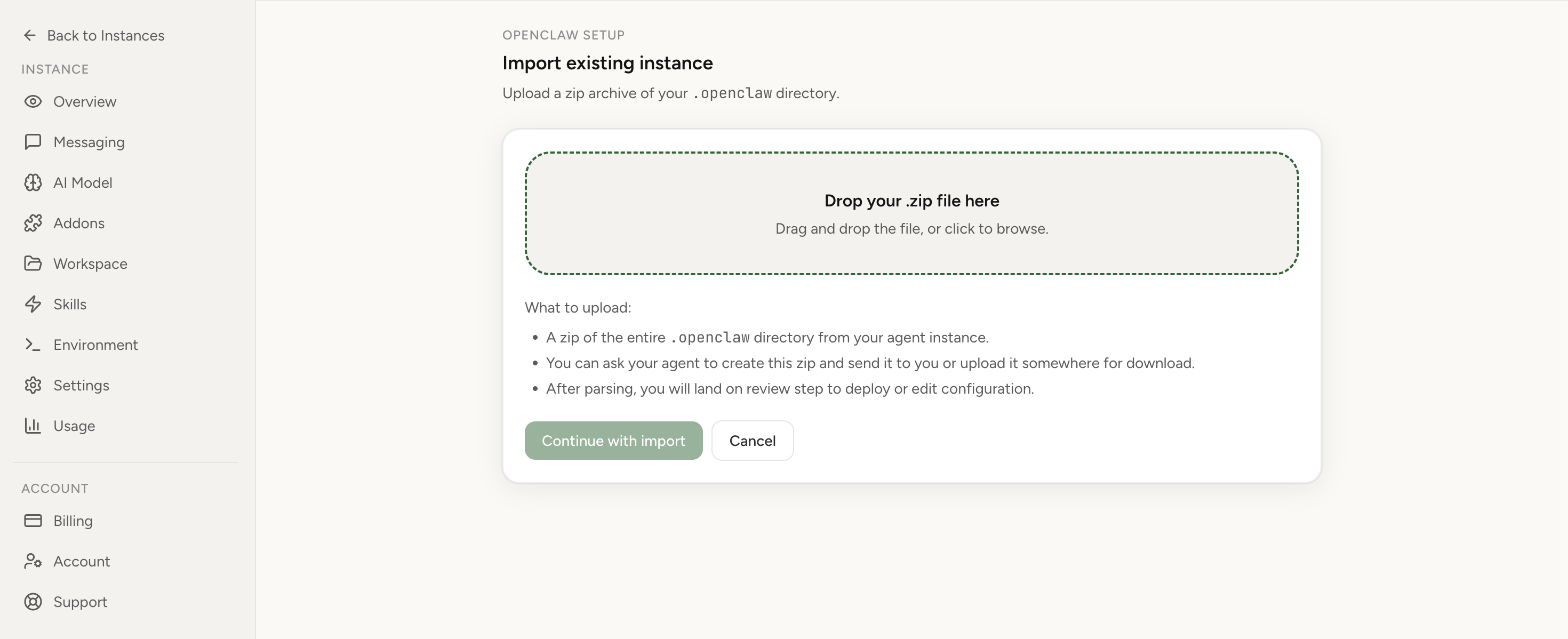
If this keeps coming back, you can move your existing setup to managed OpenClaw cloud hosting instead of rebuilding the same stack. Import your current instance, keep your context, and move onto a runtime with lower ops overhead.
- Import flow in ~1 minute
- Keep your current instance context
- Run with managed security and reliability defaults
If you would rather compare options first, review OpenClaw cloud hosting or see the best OpenClaw hosting options before deciding.
FAQ
Should I roll back immediately if logs stop working after an upgrade?
Not immediately. First prove whether the problem is isolated to the logging path. If the runtime is otherwise healthy, you have enough time to make a controlled rollback decision instead of an emotional one.
Does this issue mean my automations are unsafe to run?
Not by itself. It means your visibility is degraded. The risk is that reduced observability can hide other failures, which is why restoring log access or a reliable workaround is urgent.
What should I link to next if I am evaluating whether to stay self-hosted?
Start with the OpenClaw comparison page, review the managed runtime tradeoffs on OpenClaw cloud hosting, and if browser-driven workflows matter, review Chrome Extension Relay to see how local-browser access fits into a more stable setup.