Managed OpenClaw remote access without public IP risk
Problem statement: you need remote access to OpenClaw from outside your local network, but opening public ports creates security risk. Self-hosting on a VPS exposes your instance to scanning, exploitation, and operational burden. Laptop deployments go offline when you travel. Browser-based solutions require third-party relays you may not trust. You want secure remote access that works from anywhere without public IP exposure or infrastructure overhead.
- Worklog
2026-04-03-tailscale-sidecar.mddocuments per-instance Tailscale sidecar support including encrypted auth key storage, live status monitoring, and label-scoped UDP egress policy. - Recent community discussion highlights teams comparing managed hosting options specifically around remote access and security tradeoffs.
- Users are discussing self-hosting on VPS versus hosted solutions when uptime and secure remote access are primary concerns.
- The Chrome Extension relay architecture provides secure browser control without public relay endpoints when combined with private networking.
Why public IP exposure is unacceptable for OpenClaw
Opening ports to the public internet transforms your OpenClaw instance from a local tool into an attack surface. Security scanners find open ports within hours of exposure. Vulnerability in OpenClaw or its dependencies becomes a remote exploit opportunity. Even with authentication, you face credential stuffing, brute force attempts, and protocol-level attacks.
- Continuous scanning: botnets scan the public internet constantly for open ports on common services.
- Credential exposure risk: authentication credentials can be captured through logs, leaks, or session hijacking.
- DDoS amplification: public endpoints can become DDoS amplification targets or victims.
- Compliance problems: many organizations prohibit exposing AI agent endpoints to the public internet.
- Operational overhead: you must maintain firewalls, fail2ban, TLS certificates, and security monitoring indefinitely.
The traditional self-hosting solution—put OpenClaw on a VPS and lock it down—sounds straightforward but creates ongoing operational burden that most teams underestimate.
The self-hosting dilemma: VPS, laptops, and tradeoffs
Self-hosters face a choice between bad options for remote access:
VPS deployment with public ports
Deploying OpenClaw on a VPS gives you a public IP and reliable uptime, but you must open ports to access it remotely. This exposes you to the security risks above. Mitigating these risks requires:
- Configuring and maintaining firewall rules.
- Setting up fail2ban or similar intrusion prevention.
- Managing TLS certificates and HTTPS reverse proxies.
- Monitoring logs for intrusion attempts.
- Keeping OpenClaw and all dependencies updated against CVEs.
The monthly cost of a VPS is only the beginning. The real cost is the time spent on security operations instead of using your agents.
Laptop deployment with Tailscale
Running OpenClaw on a laptop with Tailscale gives you private remote access without public IPs, but introduces reliability problems:
- Your instance goes offline when your laptop sleeps or shuts down.
- Long-running tasks fail when you close the lid or move networks.
- Team members cannot access the instance when you are away from your machine.
- Resource contention affects your laptop performance during intensive agent tasks.
- Accidental shutdowns lose in-progress work and disrupt workflows.
This approach works for individual experimentation but fails for team operations that require reliable availability.
How managed hosting solves the remote access problem
Managed OpenClaw hosting combines the security of private networking with the reliability of cloud infrastructure:
- No public ports required: access your instance through private networks or browser relay, never through public IPs.
- Always-on availability: your instance stays online regardless of your local device status.
- Built-in security hardening: the platform handles container isolation, credential management, and security updates.
- Team access without VPN complexity: invite team members through access controls instead of configuring VPN infrastructure.
- Import your existing setup: move from self-hosted to managed without losing context or rebuilding workflows.
Private networking with Tailscale integration
Managed OpenClaw hosting includes first-class Tailscale support:
- Per-instance sidecar: each instance gets its own Tailscale sidecar with isolated networking.
- Encrypted credential storage: your Tailscale auth key is stored encrypted in the instance database, not in environment variables.
- Live status monitoring: the Addons UI shows connection state, IP assignment, UDP availability, and relay risk in real-time.
- Stable hostnames: your instance gets a stable hostname based on the instance resource name, avoiding MagicDNS churn after redeploys.
- Label-scoped policies: NetworkPolicy for UDP egress is scoped to Tailscale-enabled pods, preserving security for other workloads.
With Tailscale enabled, your OpenClaw instance appears as a device on your tailnet. Access it from your laptop, phone, or any other device with Tailscale installed—all traffic flows through encrypted WireGuard tunnels without touching the public internet.
Browser relay for automation workflows
For browser automation, managed hosting supports the Chrome Extension relay:
- Secure tab control: attach real browser tabs from your local Chrome to hosted OpenClaw for automation.
- Private relay path: when combined with Tailscale, relay traffic stays within your private network.
- No public relay exposure: unlike cloud relay services, traffic flows between your devices and your instance.
- Token isolation: relay sessions use scoped tokens that cannot access other instance functionality.
This combination is powerful for teams that need browser automation but want to avoid exposing relay endpoints publicly. See Chrome Extension relay architecture for details on how the relay system works.
Comparing remote access options
Self-hosted VPS with public ports
- Pros: full control, predictable monthly cost, works from anywhere.
- Cons: public IP exposure, ongoing security operations, TLS certificate management, vulnerability to CVEs.
- Best for: users with security operations expertise who want maximum control and accept the operational burden.
Self-hosted laptop with Tailscale
- Pros: no public exposure, zero hosting cost, private networking through Tailscale.
- Cons: unreliable availability, resource contention, single point of failure on your laptop.
- Best for: individual experimentation and personal use where reliability is not critical.
Managed hosting with Tailscale and relay
- Pros: no public ports, always-on availability, built-in security, team access, import existing instances.
- Cons: hosting fees (offset by reduced ops burden), dependence on platform reliability.
- Best for: teams that want secure remote access without managing infrastructure or security operations.
Migrating from self-hosted to managed hosting
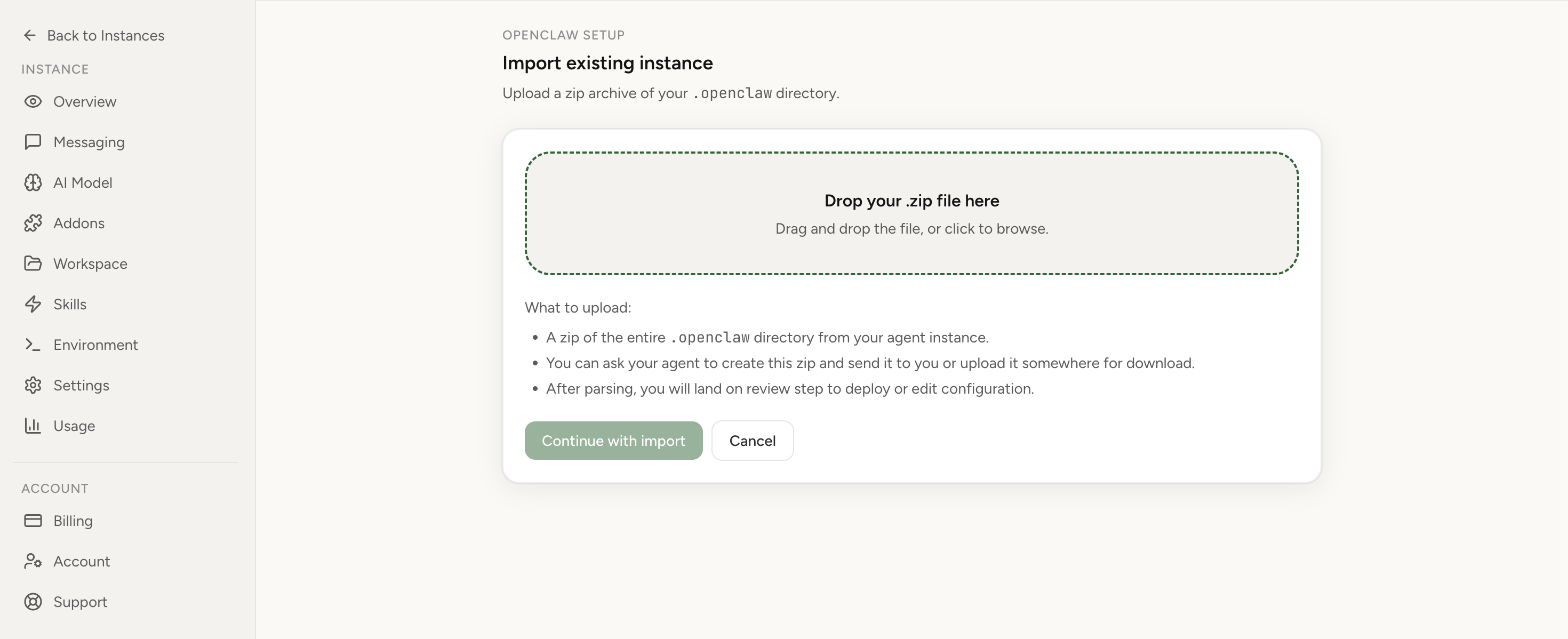
The import process preserves your existing setup while moving you to a secured environment:
- Export your current OpenClaw instance configuration and context.
- Create an account at app.openclaw-setup.me and initiate the import flow.
- Paste your import payload—the platform reconstructs your instance in a secured runtime.
- Enable Tailscale in the Addons tab for private remote access.
- Verify connectivity from your local devices through your tailnet.
- Decommission your self-hosted instance once you have confirmed migration success.
This migration typically takes less than a minute for the actual import, plus whatever time you need to verify and cut over. Your memory, workflows, and configuration remain intact—only the hosting environment changes.
A practical next step
If you already have a working self-hosted setup, the shortest path to secure remote access is not a rebuild. Import your current OpenClaw instance in 1 click, then enable private networking and browser relay only where you need them.
Start with OpenClaw Setup login, review hosting comparisons, and confirm the managed runtime details on OpenClaw cloud hosting.
Security advantages beyond remote access
Eliminating public IP exposure is only one security benefit of managed hosting:
- Privilege isolation: the Tailscale sidecar runs with elevated network privileges, but the main OpenClaw container remains non-root with dropped capabilities.
- Container security: the platform runs OpenClaw in isolated containers with resource limits and security policies.
- Dependency management: security updates and dependency patches are handled by the platform.
- Incident response: platform operators monitor and respond to security incidents at the infrastructure level.
- Compliance support: managed environments provide audit trails, access controls, and policy enforcement suitable for organizational use.
Cost comparison: self-hosted vs managed
When evaluating costs, consider the total cost of ownership:
- VPS monthly cost: $5-50 per month depending on resources.
- Security operations time: monitoring logs, applying updates, responding to incidents.
- Incident recovery cost: time spent recovering from compromises or breaches.
- Managed hosting cost: predictable monthly fee that includes security operations and infrastructure.
For teams that value their time, managed hosting often costs less in practice when you account for the operational overhead of self-hosting securely. See OpenClaw hosting cost comparison for detailed TCO analysis.
When to choose managed hosting for remote access
Managed hosting is the right choice when:
- You need remote access but cannot accept public IP exposure risk.
- Your team requires reliable availability that laptop deployment cannot provide.
- You do not have dedicated security operations expertise or capacity.
- You want to avoid the operational burden of maintaining VPS security.
- You need to onboard team members without configuring VPN infrastructure.
- You value predictable costs over variable security operations overhead.
Compare managed hosting options at /compare/ to see which provider matches your requirements for remote access, security, and reliability.
Edge cases and limitations
- Cluster egress requirements: your cluster must allow outbound connectivity to Tailscale coordination servers and DERP relays.
- Tailnet management: you still need to manage Tailscale ACLs and tailnet membership for access control.
- Network policy interactions: some Kubernetes network policies may interfere with Tailscale UDP traffic.
- Import size limits: very large instances with extensive memory may require special handling during import.
- Feature parity: confirm that any OpenClaw features you rely on are supported in the managed environment.
Typical mistakes when evaluating remote access options
- Assuming a firewall rule is sufficient security for a public OpenClaw endpoint.
- Underestimating the time required for security operations on a self-hosted VPS.
- Choosing laptop deployment without considering availability requirements.
- Ignoring the cost of security incidents when comparing hosting options.
- Forgetting that TLS certificates on self-hosted instances expire and need renewal.
- Assuming all managed hosting providers offer equivalent security and access features.
Getting started with managed remote access
If you are ready to eliminate public IP exposure while maintaining reliable remote access:
- Review managed OpenClaw setup to get started in minutes.
- Compare hosting providers at /compare/ to find the best fit for your requirements.
- Create an account and import your existing OpenClaw instance if you have one.
- Enable Tailscale in the Addons tab for private networking.
- Install Tailscale on your local devices and verify connectivity.
- Enable Chrome Extension relay if you need browser automation capabilities.
FAQ
Is managed hosting more expensive than self-hosting?
Managed hosting has a clear monthly fee, while self-hosting has hidden costs in security operations time, incident recovery, and opportunity cost. For most teams, managed hosting costs less in practice when you account for the operational burden.
Can I use managed hosting without Tailscale?
Yes. Managed hosting provides browser-based access through the Control UI without requiring Tailscale. However, Tailscale enables general network access to your instance, which is useful for CLI tools, API clients, and development workflows.
What happens if my Tailscale auth key expires?
The Tailscale sidecar will lose authentication and disconnect from your tailnet. Update the auth key in the Addons tab and the instance will reconnect. The platform supports both one-time and reusable auth keys depending on your security preference.
Can multiple team members access the same instance?
Yes. Any device on your tailnet can reach the instance, and you can invite team members to access the instance through the managed hosting platform. Access controls determine who can modify configuration versus who can only interact with the agent.
Does browser relay work without Tailscale?
Yes. Browser relay works through the Control UI even without Tailscale enabled. However, combining Tailscale with relay gives you private relay paths that do not expose endpoints publicly.
Sources
- Tailscale: secure, private WireGuard-based mesh networking
- Chrome Extension relay architecture: secure browser control
- OpenClaw cloud hosting: managed platform with Tailscale and relay support
- Self-hosted vs managed OpenClaw hosting comparison
- OpenClaw hosting cost: managed vs self-hosted pricing analysis
- Detailed Tailscale setup guide for OpenClaw
- Worklog entry
2026-04-03-tailscale-sidecar.md: per-instance Tailscale sidecar implementation including encrypted auth key storage, live status, and label-scoped UDP egress policy