OpenClaw one-click hosting checklist before you move
Problem statement: OpenClaw hosting is being sold with faster and faster setup promises. Guided setup sessions, one-click deploy buttons, and prebuilt server templates all sound attractive when your laptop sleeps, your gateway needs babysitting, or your team does not want to maintain Docker, ports, Node, browser access, and channel credentials by hand. But the real question is not whether someone can start a server. The real question is whether your agents, context, cron jobs, browser workflows, credentials, logs, and rollback path survive the move.
- Recent public posts about OpenClaw repeatedly highlight guided setup, one-click deployment, and avoiding DevOps work. That is a real user desire, but it also creates room for shallow hosting claims.
- Public hosting pages and community discussion keep returning to the same pain points: laptops sleep, background agents need uptime, ports and Node dependencies are annoying, and API or OAuth credentials become risky when copied around casually.
- In our own OpenClaw Setup environment, a healthy gateway check needs more than “the machine exists.” We look for a working connectivity probe, an actual listening gateway, dashboard access, and clear boundaries around external channels and addons.
- A remote host without a public-IP assumption is a useful baseline. Secure access, browser relay, logs, and recovery should be designed features, not improvised after the first deploy.
What one-click hosting should actually mean
A one-click deploy can be valuable. It removes the blank-server problem: install Node, choose a process manager, expose a dashboard, set environment variables, wire channels, and hope the gateway stays alive. But OpenClaw is not just a static web app. It is an agent runtime with memory, tools, browser access, channels, schedules, credentials, and logs. If a provider only gives you a server with OpenClaw installed, the hard part may still be yours.
Use the checklist below before you move. It is written for founders, agencies, operators, and technical teams who want less maintenance without losing control of how their agents work.
The preservation checklist
- Workspace context: memory files, working directories, local notes, and project-specific instructions.
- Agents: model settings, provider choices, system instructions, skills, tools, and any per-agent state.
- Cron jobs: schedules, target sessions, payloads, timezone assumptions, retries, and delivery surfaces.
- Channels: Telegram, Slack, Discord, WhatsApp, email, webhooks, or other integrations that need credentials and callback behavior.
- Browser access: whether workflows use a hosted browser, your real local Chrome, or a relay. If real-browser access matters, review Chrome Extension relay before choosing a host.
- Credentials: API keys, OAuth tokens, channel secrets, provider keys, and who can read, rotate, or revoke them.
- Logs and recovery: where logs live, how long they are kept, how restart loops are surfaced, and what support can actually inspect.
- Rollback: how you return to the old instance if the migration fails a real workflow.
Move the instance, not just the install
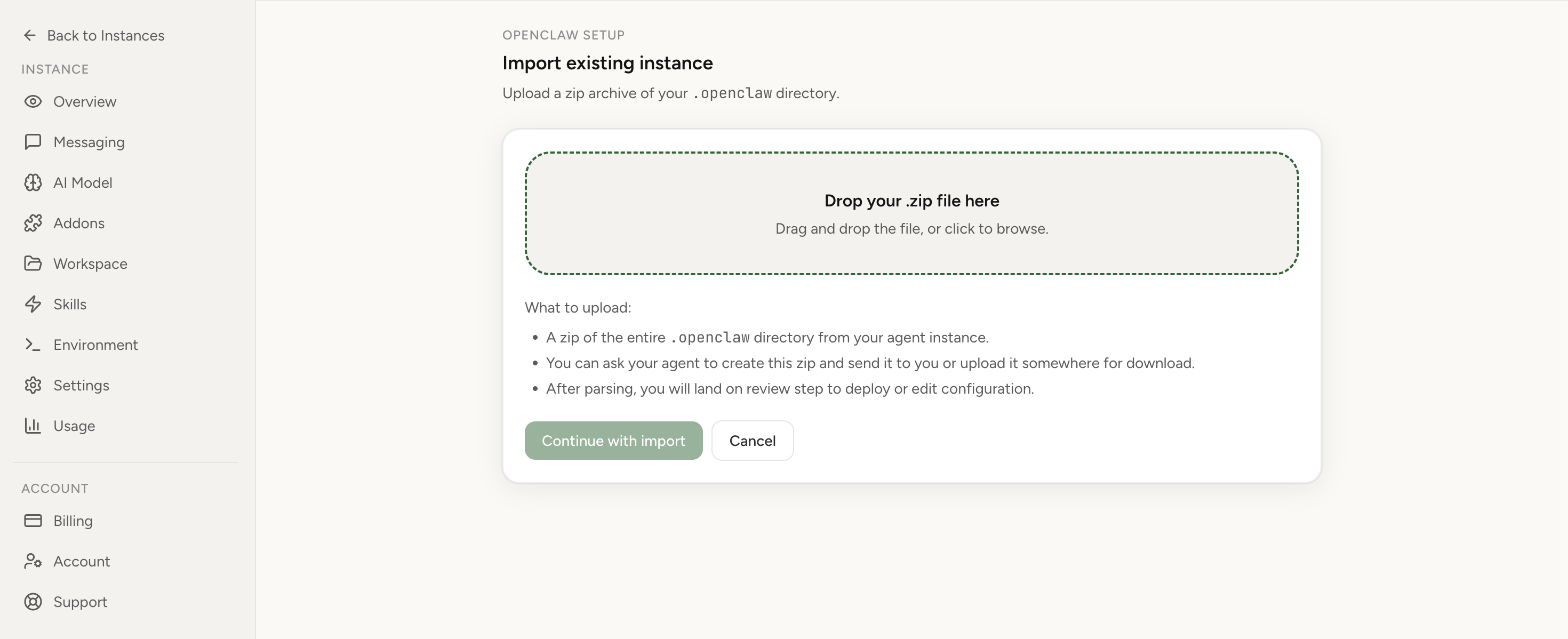
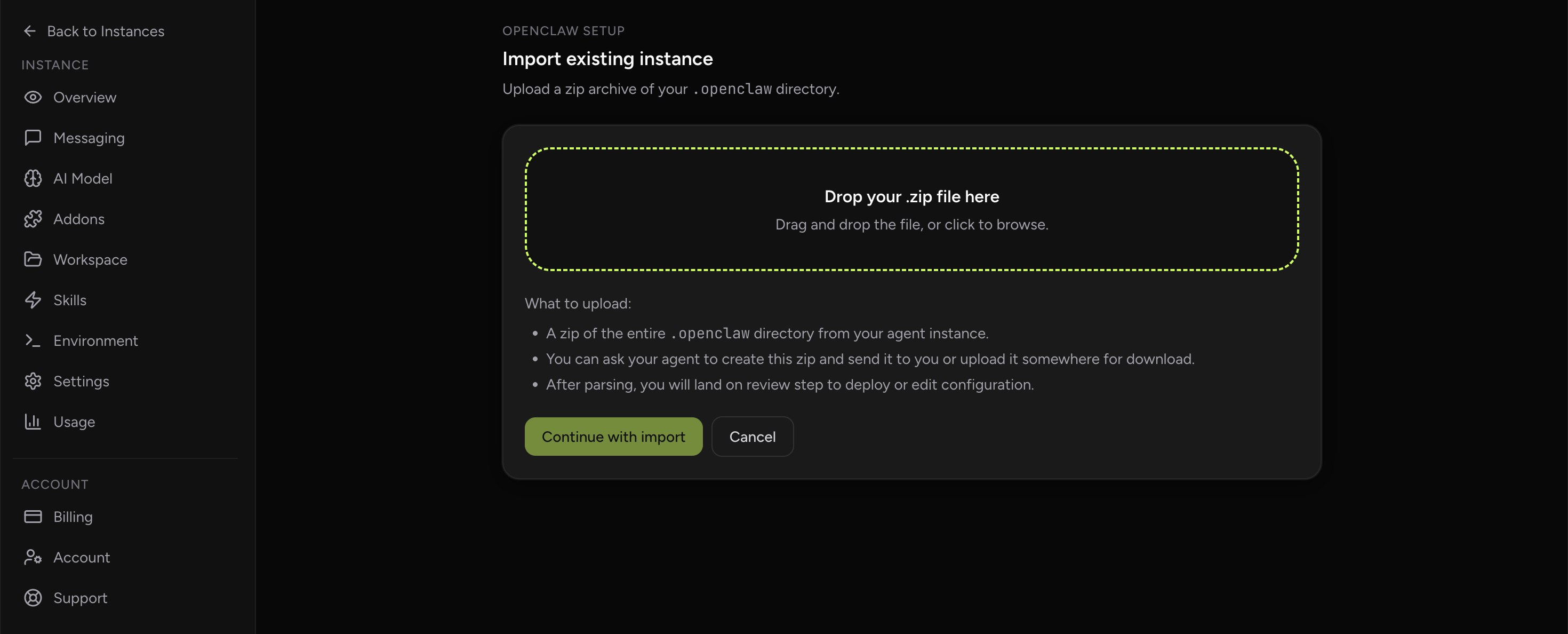
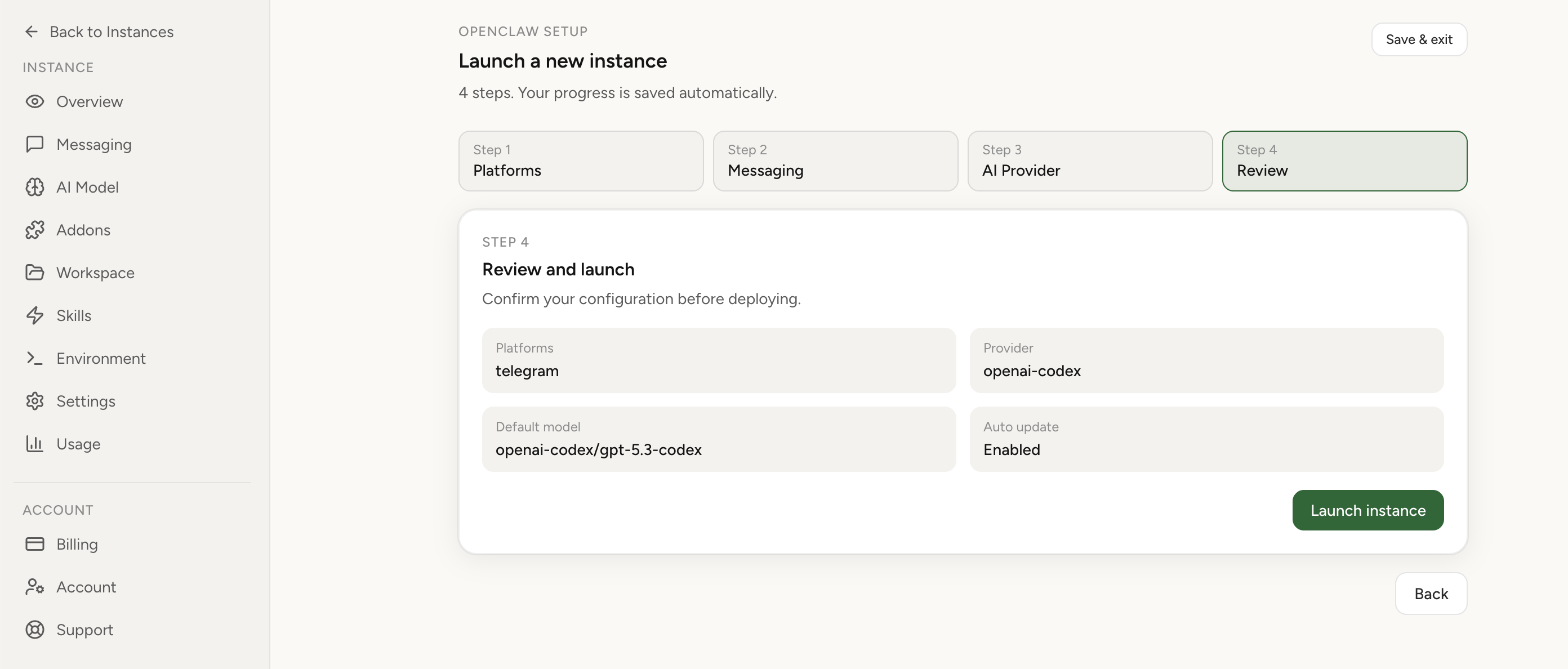
If you already have OpenClaw running, the safest path is to import the current instance instead of rebuilding from memory. That gives you a cleaner way to preserve context, review what moved, and verify the new runtime before depending on it.
Questions to ask before you choose a host
Who owns the API keys?
Bring-your-own-key hosting is common, but the details matter. Ask where keys are stored, who can read them, how rotation works, whether logs can expose them, and what happens when a teammate leaves. A low monthly server price is not a bargain if migration turns your credentials into loose text files.
How does import actually work?
A provider should explain whether it imports configuration, workspace context, agents, cron jobs, and channel settings, or whether it merely gives you a blank OpenClaw instance. “One click” is only meaningful if the click preserves the parts that make your current setup valuable.
How are browser workflows handled?
Browser control is often the hidden migration blocker. Some teams need a hosted browser for repeatable workflows. Others need their local Chrome because the useful session is already logged in. If your agent works with real websites, dashboards, ads managers, analytics tools, or internal admin panels, decide this before moving. OpenClaw Setup supports managed hosting and a relay-based browser pattern so you do not have to copy cookies around.
What happens when the old laptop sleeps?
This is one of the strongest reasons to move. If your agent monitors messages, runs scheduled jobs, or waits for background events, a personal laptop is the wrong reliability boundary. A managed host should keep the instance available without requiring the user’s machine to stay awake.
Can updates be rolled back?
OpenClaw moves quickly. A real hosting provider needs an update plan, not only an install button. Ask how updates are applied, how failed updates are detected, and whether you can roll back or pause upgrades while keeping the instance secure.
Step-by-step migration plan
- Inventory the current instance. List agents, providers, channels, cron jobs, browser workflows, memory files, and external dependencies.
- Decide what must move. Separate essential state from old experiments. Migration is a good time to avoid carrying broken jobs forward.
- Export or import through the designed path. Prefer a product-supported import flow over manual copying.
- Verify credentials without exposing them. Confirm keys and OAuth flows work, then rotate anything that was handled insecurely during the move.
- Test channels one at a time. Send a controlled Telegram, Slack, Discord, email, or webhook message before enabling all production traffic.
- Test browser access. Attach a tab, take a snapshot, or run a small browser task that represents your real workflow.
- Test cron. Run one job manually, then wait for one scheduled fire so you verify both payload and scheduler behavior.
- Keep a rollback window. Do not delete the old instance until the new host passes the workflows that matter.
Typical mistakes
- Choosing the cheapest VPS only. A cheap server can still leave you responsible for updates, logs, security, backups, and recovery.
- Ignoring browser access. If the agent’s value depends on logged-in web apps, browser strategy is not optional.
- Moving secrets manually. Copying keys through ad hoc notes or messages creates exposure you may forget to clean up.
- Not testing cron. A migrated dashboard can look healthy while scheduled jobs are still pointed at the wrong session or channel.
- Confusing a public IP with secure remote access. Reachability is not the same as access control.
- Assuming one-click means managed operations. Installation speed is only the first minute. Operations are everything after that.
How to verify the new host is ready
Treat migration as incomplete until the new instance passes real checks. The dashboard should load from the expected account. An agent should answer through the normal channel. At least one cron job should run. A browser workflow should attach if browser work matters. Logs should be accessible without opening unsafe server access. The old laptop should be able to sleep without breaking the hosted agent. You should know how to roll back if the next update or workflow test fails.
Where OpenClaw Setup fits
OpenClaw cloud hosting is built for people who want OpenClaw available without turning every agent into a server-maintenance project. OpenClaw Setup focuses on the practical pieces around the runtime: instance management, external channels, addons, import, and safer browser access. If you are comparing approaches, use the comparison page to decide whether you need a simple VPS, self-hosting, or a managed OpenClaw-specific control plane.
FAQ
Can I just reinstall OpenClaw on a new server?
You can, but reinstalling is not the same as migration. A reinstall may lose memory, agents, schedules, browser assumptions, and channel settings unless you deliberately preserve them.
Do I need managed hosting if I am technical?
Not always. Technical teams can self-host well. Managed hosting makes sense when uptime, team access, browser workflows, external channels, or update recovery cost more than the hosting fee.
What is the safest first move?
Start with an inventory and an import path. Move a copy, test real workflows, and keep the old instance available until the new one proves it can handle daily work.
What should I compare between providers?
Compare import depth, credential handling, browser access, logging, backups, update policy, rollback, support, and whether the provider understands OpenClaw specifically rather than only offering a generic server.