OpenClaw Telegram duplicate progress messages: fix noisy live output
Problem statement: a Telegram user runs OpenClaw, sees duplicate progress or print-style messages, and one of the copies disappears later. The final chat may look almost correct, but the live experience feels broken. For a personal assistant this is annoying. For a shared team bot, it creates mistrust: users cannot tell whether the agent is retrying, duplicating work, or about to send the final answer twice.
This guide shows how to diagnose duplicate Telegram progress messages without confusing them with duplicate final answers, media attachment duplication, or normal status cleanup. The fix path is mostly operational: capture the live sequence, classify which message type duplicated, verify the cleanup behavior, and only then decide whether to update, downgrade, or temporarily reduce progress rendering.
- On 2026-05-06, a Telegram user replied to the OpenClaw 2026.5.6 release announcement on X and reported that after trying 5.5 and 5.6, Telegram still showed duplicate print results, although one automatically disappeared at the end.
-
The same release announcement mentioned maintenance fixes around Codex OAuth routes, plugin fetch behavior, and
web_fetchtimeout cleanup. That matters because operators often assume a maintenance release fixed all chat-surface noise. The user report shows Telegram progress rendering still needed separate verification. - GitHub issue #78767, opened on 2026-05-07, reports a related but distinct WhatsApp delivery problem where captioned MEDIA directive replies could send an attachment twice. The lesson is to classify duplicates by surface and payload type before applying a fix.
- OpenClaw Setup operating practice treats transient-message cleanup as part of delivery quality. A message that eventually disappears is better than a permanent duplicate, but it is not automatically healthy if users see confusing output during the run.
First classify the duplicate
Do not start by changing configuration. Start by naming the duplicate. In Telegram delivery, several things can look like the same bug from the chat window: a progress message, a tool status, a printed intermediate result, a media attachment, or the final assistant answer. They have different causes and different fixes.
- Transient progress duplicate: two status messages appear while the agent is working, then one is edited or deleted.
- Final answer duplicate: the actual assistant answer is delivered twice and stays twice.
- Tool-output duplicate: a command or tool result is printed twice, even if the final answer is single.
- Media duplicate: an attachment or captioned media reply is sent twice.
- Retry duplicate: delivery fails once, retries, and both attempts become visible.
Why transient duplicates happen
1) Status create/edit race
Progress UX often relies on creating a placeholder message and editing it as work continues. If the runtime loses track of the message ID, creates a second placeholder, or receives events out of order, users can briefly see two copies. Cleanup may remove the extra copy later, but the live sequence still looks wrong.
2) Surface-specific rendering rules
Telegram, WhatsApp, Discord, and Slack do not behave the same way. Some support edits cleanly. Some handle media and captions differently. Some rate-limit edits or return delivery responses that need careful handling. A fix for one channel can leave another channel unchanged.
3) Progress and final delivery using separate paths
OpenClaw can send progress updates while a model or tool call is running, then send the final answer through a different delivery path. If only the final path is verified, you may miss duplicate progress messages. If only progress is watched, you may miss duplicate final answers.
4) Retries without idempotency
Retry logic is good when a delivery call fails. It is dangerous when the first call actually succeeded but the runtime did not receive a clean acknowledgement. Without idempotency keys or careful message-ID tracking, a retry can create visible duplicates.
Step-by-step diagnostic flow
Step 1: reproduce from Telegram, not only the web UI
Run the exact action from Telegram. A browser chat or CLI test will not prove Telegram delivery behavior. Use a short prompt first, then the prompt that originally showed duplicates. Record the screen if you can, because transient duplicates may disappear before you inspect logs.
Step 2: write down the live sequence
Capture the order: user prompt, first progress message, second progress message, edits, deletion, final answer, and final cleanup. Note whether the duplicate is visible for seconds or minutes. The duration tells you whether this is a minor cleanup delay or a serious delivery race.
Step 3: inspect gateway logs around message IDs
Look for Telegram send, edit, delete, and retry calls. The key question is whether OpenClaw knowingly created two messages or created one message and then rendered it twice through a progress pipeline. If logs show two successful sends for the same progress event, focus on status creation. If logs show one send and repeated edits, focus on client rendering and cleanup timing.
Step 4: separate progress from final delivery
After the run completes, inspect the final chat state. There should be one final answer and no stale progress duplicates. If the final state is clean but the live state is noisy, you are dealing with progress UX. If the final answer is duplicated, treat it as a higher-severity delivery issue.
Step 5: compare one stable previous build
If the duplicate appears after an update, test a known-good previous build in a disposable environment with the same Telegram bot token and prompt. Do not downgrade production blindly. The goal is to determine whether the issue is release-sensitive or caused by local channel state.
Fix once. Stop recurring Telegram duplicate progress messages.
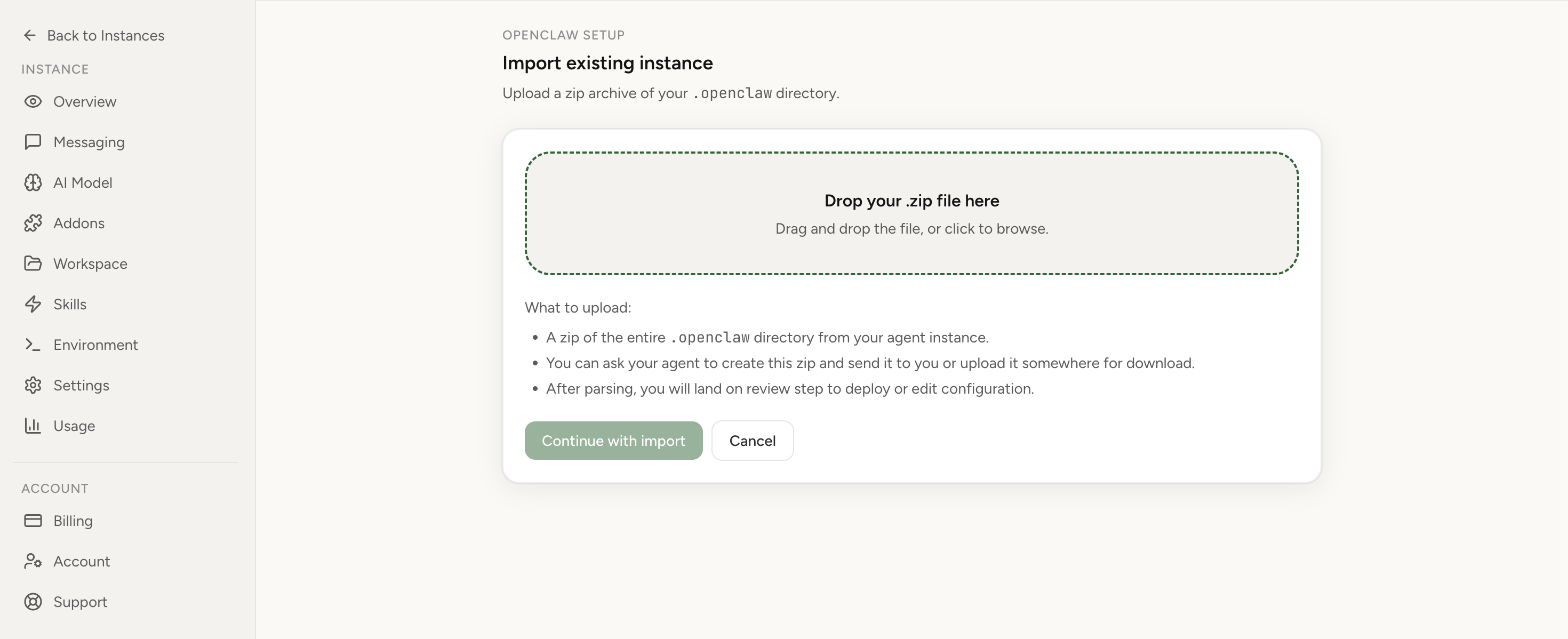
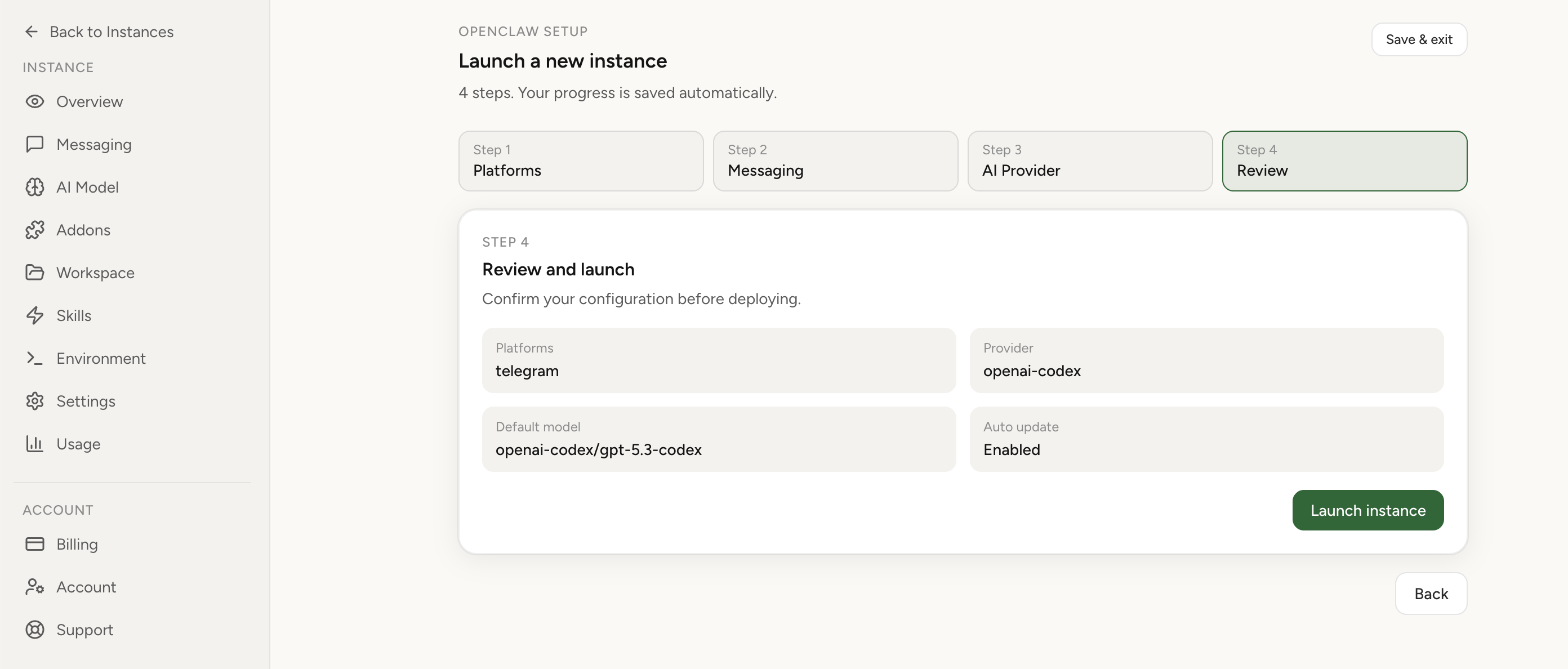
If this keeps coming back, you can move your existing setup to managed OpenClaw cloud hosting instead of rebuilding the same stack. Import your current instance, keep your context, and move onto a runtime with lower ops overhead.
- Import flow in ~1 minute
- Keep your current instance context
- Run with managed security and reliability defaults
If you would rather compare options first, review OpenClaw cloud hosting or see the best OpenClaw hosting options before deciding.
Practical containment options
Option 1: reduce noisy progress updates for shared chats
If the bot is used in a shared Telegram group, noisy progress is worse than silent progress. Temporarily reduce progress verbosity while you verify the fix. Keep final answers enabled and make sure failures still produce a clear error instead of leaving users with no feedback.
Option 2: route high-stakes work to a cleaner surface
For customer-facing or team-critical tasks, run the workflow from a surface where delivery is clean until Telegram is verified again. This is not a permanent solution, but it protects trust while you isolate the Telegram-specific behavior.
Option 3: pin a known-good build after testing
If a newer build introduces duplicate live output and a previous build is clean, pin the known-good build while tracking the upstream fix. Keep the test narrow: same bot, same prompt, same channel, same final-state inspection.
Option 4: add delivery acceptance checks to cron jobs
Scheduled jobs that report into Telegram should verify the final chat state when possible. A cron job is not healthy just because it ran. It is healthy when the intended message appears once, stale progress messages are gone, and the user can understand the result.
Typical mistakes
Mistake 1: treating eventual cleanup as a full fix
If one duplicate disappears at the end, the final state is better, but the live run can still feel broken. For long tasks, users may stare at duplicate messages for minutes. That is a real UX issue.
Mistake 2: assuming WhatsApp and Telegram duplicates are the same bug
They may share delivery concepts, but media handling, caption behavior, progress editing, and retry semantics differ. Use the WhatsApp media report as a reminder to classify payloads, not as proof of the Telegram root cause.
Mistake 3: testing only the final answer
A final answer can be correct while the progress stream is noisy. Watch the whole run from the user's view, especially for tasks that take long enough for progress messages to matter.
Mistake 4: deleting all progress UX permanently
Progress messages are valuable when an agent is running tools, browsing, or waiting on a model. The durable fix is predictable create/edit/ cleanup behavior, not making every long task look frozen.
Verification checklist
- Run a short Telegram prompt and confirm only one progress message is visible at a time.
- Run a longer tool-using prompt and record the live sequence from Telegram.
- Confirm the final answer appears exactly once.
- Wait for cleanup and confirm no stale progress messages remain.
- Check gateway logs for duplicate send calls, retries, edits, and deletes.
- Repeat the same test after any upgrade before declaring the channel healthy.
When managed hosting helps
Telegram delivery quality depends on more than the bot token. Runtime upgrades, channel plugins, model latency, retries, and progress rendering all interact. Managed hosting gives you a cleaner baseline for upgrades and monitoring so delivery regressions are easier to isolate. It also reduces the temptation to keep stacking local workarounds onto a noisy runtime.
If you want to keep your existing OpenClaw context while reducing operations work, import the current instance into OpenClaw Setup and review the delivery behavior from a managed baseline. For the broader operational tradeoff, see OpenClaw Setup compared with self-hosting. If your team also needs browser workflows, review the Chrome Extension relay.
FAQ
Is a temporary duplicate progress message severe?
It depends on the audience. In a private chat it may be a nuisance. In a team channel or customer-facing workflow, it is a trust problem and should be fixed before rollout.
What if one duplicate disappears automatically?
Treat that as partial cleanup, not proof that the run was healthy. Measure how long the duplicate stayed visible and whether users could mistake it for duplicated work.
Can I fix this by creating a new Telegram bot?
Usually no. A new bot token may clear unrelated state, but duplicate progress messages are more often caused by delivery logic, retries, or message cleanup behavior.
What is the safest rollout rule?
Before upgrading a production Telegram bot, run a live Telegram smoke test that checks the full sequence: progress, final answer, cleanup, and logs. Do not rely only on a successful model response.